Saturday, June 10, 2023

Post 40: Finishing the fretboard

    I worked on the fretboard for the last couple of days, deepening and widening the cuts for the frets, first using the very thin saw I started the slot with , then a slightly wider blade Japanese saw, and finally with my "proper" fretboard saw. There is no depth gauge on the saw, so I just draw a line on the blade with a black Sharpie about 3/32" from the teeth. 

    I then make sure the depth of the cut is sufficient using a section of fret wire on which I sanded off the barbs of the kerf.  The frets are cut slightly too long and then hammered in with the mallet on the anvil. I didn't use any glue, I believe the ebony is hard enough to hold them. I hammer the edges especially hard, and then bend them in some more and blunt them with a small brass hammer. 

     Fingers crossed!

        After sanding the ends of the frets and rounding them with a fret file, it is actually beginning to look pretty good, with the large brass dots matching the fret color:

         I will do some more filing and sanding, till it is as smooth and "perfect" as I can achieve with my limited skills and tools. I still need to check the frets are level, try to get them level with the mallet, and possibly sand them level if absolutely necessary.

Thursday, June 8, 2023

Post 39: Sanding the fretboard, AGAIN

     Well, I was not satisfied with the fretboard. The 13" radius was fairly constant all the way down, but it wasn't perfectly flat. The ebony board has a slight curve and some flexibility, so I drilled 3 holes in the fretboard where dots will go and screwed it to a flat piece of 2x2. I used a perfectly straight board of padouk as a flat base for a long strip of 80-grit sandpaper I attached with double-stick tape.  I could clearly see the shiny low spots as soon as I started sanding the fretboard:


      I kept sanding till all the shiny spots disappeared. The resulting fretboard has a radius varying from 13" at the nut to about 15 or 16 at the other end. It is actually a good thing as that will allow for a flatter bridge. It's now time to place the dots and sand them down level with the fretboard.

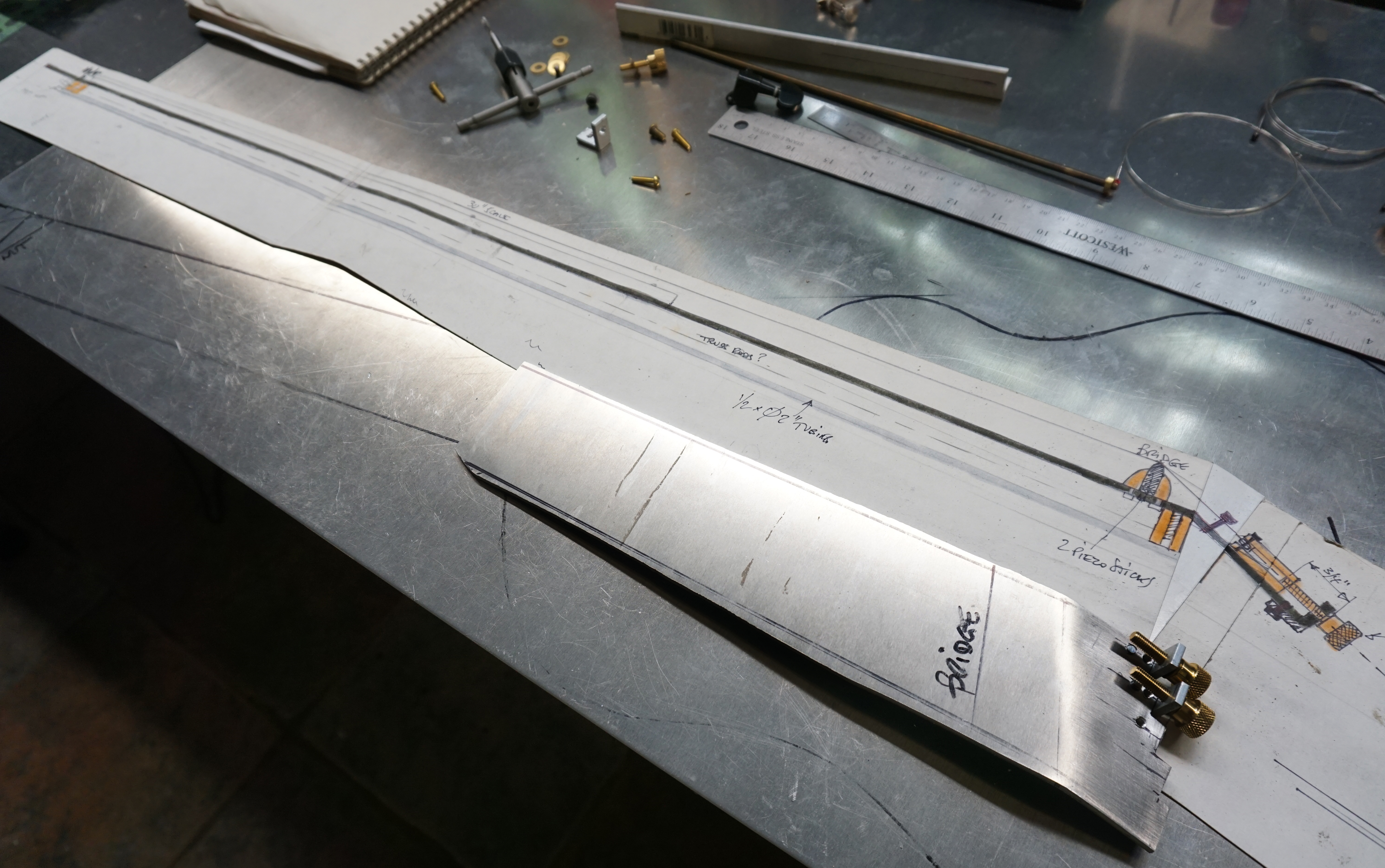
     Speaking of the bridge, it will need to be quite low, so I plan to recess the two piezo sticks into the 1/8" aluminum top, cutting a slot in it and adding a small 1/8" aluminum plate on the backside. That will require taking the built apart and making a small notch in the through neck. 

    I will also cut a back panel for the body to match the front panel and attach it when I reassemble the body, including the pickup.

Tuesday, June 6, 2023

Post 38: Neck stiffener, fingerboard

      Well, I found a third option and used a piece of U-channel aluminum I had as a stiffener for the neck where the cutout for the pickup weakened it. The 2" brass screws I got, because that was all they had, came in handy to bolt the reinforcement on.  I had to cut down the channel at an angle for them to be long enough. In fact, they are long enough to add a 1/8" aluminum back panel to the guitar later.

      I went to Woodcraft yesterday to look for a nice piece of wood to use as a fingerboard, and ran across a  slab of woof I fell in love with.  At 14 board-foot, it was expensive, but I asked and got a nice discount.  I have been toying for a while with the idea to make a wooden electric bass, and this 16" x 8ft slab of Canari Wood is big enough to cut 3 guitars out of:


      It still has some bark on it, and I love the white outer wood and the colorful orange and yellow sshades of the heartwood. 


       I can visualize gluing two pieces together so a white stripe runs through the center of the guitar body and cutting a Stasi-inspired mini bass out of it:


          But that is for another post. In the meantime, I cut and shaped a piece of ebony from Woodcraft for the fingerboard with an 13" radius.  In order to get the proper radius, I used an aluminum template to scrape chalk I had rubbed on off the fingerboard to show high points and so sanded them down progressively. 


       Before I was quite there,  I marked it and slotted it for frets. The last time I did that for the lap steel, I used a miter box because the frets were straight. But the frets are slanted on this one, with a scale varying from 732mm to 768mm. So I just marked each fret end as precisely as I could with a knife mark, scored a deep fret line with a knife, and followed it with a thin fret saw:


          Here is how it looks on the baritone body with the black 7-string headless guitar locking nut and the piezo bridge roughly in place. I will use a thin piece of ebony as a spacer under the bridge instead of the oval piece of aluminum :

Thursday, June 1, 2023

Post 37: Cutout for magnetic pickup, bent tuners plate

     Today I cut out the hole in the front plate to fit the magnetic pickup and notched the neck tube to fit it in. 

       I also bent the part of the front plate where the tuners will be attached. I then cut an oval aluminum plate to fit around the bridge pieces. It looks like the tuners could be moved closer to the bridge, within the body shape. The wooden bridge will have to be flattened and raised to match the aluminum fingerboard.

     I tested the flexibility of the neck and there seems to be some give, probably because the notch for the pickup ended up deeper than expected. There are two possible options: add square tubing sections bolted on each side of the notch in the neck to stiffen it. The other is to install two truss rods.


Wednesday, May 31, 2023

Post 36: New tuner design for the 7 strings, neck bolted on

      The tuner I first made was functional, but I thought a slicker design would look better, so I made another one I liked better. I also made a brass angle piece to anchor it too which is thinner than the aluminum angle and will give it a tad more travel:

        I received the 12-24 x 2" flat-head brass screws, and used them to attach the aluminum neck to the aluminum guitar "body".  I made sure to mark the position of the dots on the 75mm scale and keep the screws off those areas in case I do the same as with the bass and use the attaching screws as the dots:

       The resulting assembly is extremely stiff, so there is no need for a truss rod at all.


Thursday, May 25, 2023

Post 35: Back to the 7 strings guitar

      I received the 7 strings pickups yesterday. I plan to use just one mounted directly recessed into the body at an angle with no plastic trim. I will cover it with a fitted brass plate

     I finally bit the nail today and cut out the aluminum blank for the body. I refined the shape sanding the edges.

I also came up with a better fanned-out layout for the 7 tuners. The section of the body they will be attached to will be bent down at an angle as explained in the last post. I am not sure yet whether the trapezoidal sliding parts of the tuners will be made out of a U-channel aluminum or cut out of solid brass.

     The section of 2" aluminum tubing will have to be thinned out some more before I attach it to the back of the body front plate with nine 1/4" screws going all the way through the back of the neck, and then cut off and sanded smooth, showing as 9 brass dot. I believe the guitar will not have a back, just a box covering the preamp, pots, and wires. The wires from the piezo and from the magnetic pickup can be routed through the neck.


       I made a tuner slider out of solid brass, and believe it is the way to go. I will make them a bit wider, out of a 1/2" x 1/2" brass bar I just bought at Metal Supermarket, and then cut them as wedges so they fit together nicely when fully extended.


       The next questions to resolve have to do with the kind of fingerboard:
               Do I fret it or leave it fretless?
               Do I make it out of wood or aluminum?
               Do I leave it flat or make it curved to match the bridge?
       I have a piece of 1/4" Padouk (barely thick enough) and a 5/16" ebony blank (not long enough for a 30" scale). If I use wood, I will need a truss rod of some sort.  
       I have a piece of 3/16" aluminum that could make a "floating fretboard" like the one on my long bass that is bolted over the neck at a slant with adjustable spacers. 


       Would it be possible to form it into a curve? Actually, a piece of 1/8" aluminum would be easier to form and the curve would give it the required stiffness. I need to try on a scrap.

Wednesday, May 24, 2023

Post 34: Thinking of a wooden 5 Strings Bass

      I like the look of those Stradi basses so much I am entertaining the idea of actually making a fretless wooden bass along those lines, even though I lack the professional woodworking equipment. 


     I happen to have a well-seasoned plank of Padouk about 4"W x 48"L x7/8"T.  That is long enough to make a one-piece body, using lighter wood for the sides of the body. 
     Ttuners must be underneath the body, as the neck ends this way:


     Here are some other examples of designs I particularly like:


      I will let all that mature a few days before I start sketching. I may run by Woodcraft to see what light-colored wood they might have in stock to make the body out of. 

Monday, May 22, 2023

Post 33: Exploring designs for the Aluminum Barytone Guitar

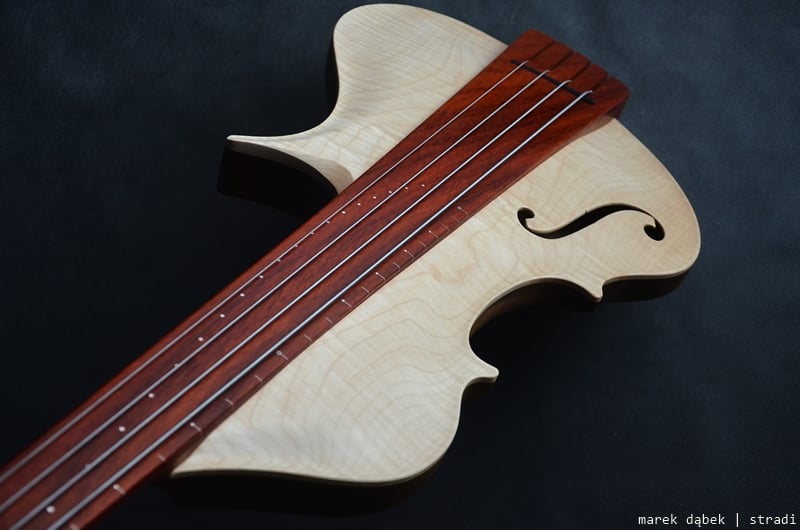
   I have spent a good deal of time in the last week or so exploring unusually creative guitar design on Pinterest, and have seen some great stuff made of wood. There are plenty of amazing custom guitar shops. One that really stands out for me is Stradi, out of Poland. They have been around for 20 years, and the stunning sophisticated simplicity of their bass designs is truly admirable:


     But as much as I would like to design and build something along those lines, I have neither the uber craftsmanship nor the woodworking equipment to do so. I better stick with my aluminum and brass rough look. I am even reconsidering using padouk sections for the body I designed. 

   But I happened to have a chuck of brass with a nice half-curve to it and Stradi inspired the idea of a slick curved piezo bridge. I finished the curve, sawed the 3/4" piece in half, and shaped the two sections with a sander. I cut and shaped a 1/4" piece of padouk to make a bridge. It's still rough, but once smoothed out and bolted to the guitar body, with two piezo sticks under the wooden bridge, I should get a good signal:


        Of course, to use that bridge, I will have to make a fingerboard with a roughly 12" radius for 7 strings or settle for 6 strings and use the ebony one I just bought on sale:

       In that case, I would need to make another matching bridge out of ebony.

      An issue I am working on is whether to use a truss rod to have some adjustment on the neck if it bends, which I doubt. But it is possible if it pulls on two brass pieces bolted to the 1/8" aluminum top itself.

     To get enough pressure on the piezo bridge, the strings need to make an angle of roughly 20 degrees, so the tuners will have to be mounted at a 20 degrees angle. I made a side drawing of the guitar:

        Another issue is whether to use the Chinese tuners I ordered:

or to make my own using some 1/2" brass thumb screws I have. I made a proof of concept mockup by bending a piece of the 1/8"aluminum, which was actually quite difficult. That stuff is stiffer than I thought. They have to be staggered and spaced precisely so they are as close as possible but do not touch. I tried to bend the little pieces at a right angle, but the aluminum broke. So I had to cut little sections of a 3/4"x3/4"x1/8" aluminum angle molding and attached them with M3 socket screws. The sliders to which the strings are attached will be made of brass and tapped to match the 10-32 thumb screws. Each tuner unit would end up being wider than the commercial ones, which means they will need to fan out slightly and the strings will require spacer posts:


Friday, May 12, 2023

Post 32: Thinking of a Baritone guitar

   Before I go any further with the ELECTRIC THEORBO, I want to let my Friend LaDonna take a look at it. Even with the shortened neck,  it is still unwieldy and requires a strap to stabilize it. I would prefer an instrument that sits in one's lap comfortably without a strap. 

   Also, I only have only one length of 2" aluminum tubing to make a neck and don't want to waste it on an instrument that nobody will mess with. These instruments are prototypes and therefore imperfect; so they are not really sellable, at least not for an amount commensurate to the work that went into making them. I would just as soon keep them and loan them to musician friends, or give them away.

   My nephew Doug is a guitar player, teacher, and collector. I already gave him the early cigar box guitar and the one-string bass. I am considering making a special guitar for him, and since I don't like high screechy sounds, I am thinking of skipping the small string altogether and making a fairly long-scale (27" to 30") baritone guitar with either 6 or 7 strings. I have a beautiful Gaboon Ebony fingerboard blank that is wide enough to accommodate 7 strings.

   I like the idea of a headless guitar with tuners at the saddle, so I ordered from Amazon a set of 6 individual black tuners with built-in brass bridges and intonation adjustment:


        I plan to stagger them, angle the nut, and fan the frets like in these:

    I also like the idea of having the body hug the neck high on one side and having a deep cut-out on the other.  I don't like high-screeching power chords, so there is no need for a deep cutout for the thumb. I like mellow sounds, so there will be no bridge pickup, just a neck humbucker.  I have so far used cheap Chinese pickup, but since this build is intended as a present for a serious guitarist, I looked for something better and unusual. I found the Lace Alumitone extended-range bar humbuckers. They look great and come in a whole range of widths for 6 to 10 strings guitars:

     My first full-scale sketch on paper looks like this:


      The holes would lighten the 1/4" aluminum top. I am wondering if I could shape a thinner aluminum panel as an archtop instead,  or do a curved back with lips bolted to the front body panel.
     I always surf Pinterest for new original designs, and just ran into this fabulous and very unique design by Rick Toone using carbon fiber panels and wood:


       It would be entirely possible to do a similar design using aluminum and Padouk, without altering the general shape I drew originally. 


      Now,  I need to make a mockup out of plywood to check the balance and the way the instrument will sit in my lap.


Saturday, May 6, 2023

Post 31: Test stringing the Theorbo

    I spent the day stringing the rough frame. I used dulcimer pins for tuning, which is not ideal, but easy to install. When I build the aluminum instrument, I will definitely need a more precise tuning system, either guitar tuners built into the body, or something I design using brass knurled screws.

   The set of short "lute" strings includes 4 sets of double strings, starting with a pair of second guitar strings, and two single #5 and #6 strings. I decided on a 60 cm scale with 16 frets. The traditional lute frets are separately tied with catgut.  I chose instead to notch the edges of the fingerboard and wrap a half-round brass wire around the neck from notch to notch as I had done with the long bass. It is difficult to keep the tension without distorting the wire, and it did not come out very well, so I will have to wrap it around the fingerboard only in the final version.

    The unfretted strings are bass guitar strings attached to an aluminum bracket bolted to the neck with a roughly 41" scale.  I originally made the neck extra long to accommodate a double bass string. I wont need it, so I went ahead and cut it down, which makes it a lot less unwieldy.


    The two pickups wired in parallel into the amp do work, but there is some unevenness in the tone and loudness of the strings that I will have to address. Moving the wide bass pickup over an inch or so should help. 

       
      Next, I will make some better bridges with built-in piezo pickups and add a preamp o see what kind of sound that produces and design a way to mix both magnetic and piezo sounds with pots.

Thursday, May 4, 2023

Post 30: What the hell is a THEORBO?

      I am constantly scouring the internet for new ideas, getting email suggestions from Pinterest every day for watercolors and instruments I might like. About a week ago, I ran across this very interesting picture of a Theorbo:


     It is basically a lute with a grafted long neck holding a set of extra-long unfretted bass strings. I was intrigued, so I searched Google for "electric theorbo" and actually turned up this twin-neck one:


     And it sounds really good too: 


   So I decided to build my own version out of aluminum and brass. Theorbos can have between a dozen and twenty or more strings,  so I decided on thirteen, because that is my lucky number. There will be 6 short lute strings and seven bass strings.
   But first, I wanted to work out the design in a wooden mockup. I cut a long neck out of a 2x4 and roughly shaped it, then glued it to a roughy-shaped plywood body.  I cut out the slots for two soap bar neck pickups and drilled the hole for the wire of an under-bridge flat piezo pickup bar.  I stained the whole thing black to make it look better, and here I am:


    The length of the neck was chosen to fit a couple of double bass strings. I ordered two sets of extra-long electric bass strings, one light, and one medium. They will require a bracket to attach them to the neck. 
   All the tuners will be on the body end, some piano pins, and the rest dulcimer pins. The dulcimer pins could be fitted with knurled knobs. 
   The fingerboard on the lute is flush with the top of the body, but since my pickup sticks up about 1/4", I will have to add a 1/4" fingerboard. The frets on the lute are normally tied gut and there ae usually only 9 or so. In this version, I will use a brass wire wrapped around the fingerboard as I did for the extra-long bass.


Post 29: Shaping the neck and fingerboard of the 6 strings Viola

       I shaped the neck and the scroll, adding a set of brass lamp caps of graduated sized alternated with black rubber washers and finished with a 1/2 brass ball.


     The fingerboard was shaped separately with planes out of mahogany and glued to the two side pieces of the neck. 

   The bridge was built out of brass and aluminum, with a curved built-in piezzo stick and a matched loose mahogany bridge piece:

       The tuners were attached to the headstock:


       Everything wood was dyed black and rubbed. 


Post 34: Thinking of a headless and fretless bass

   I would like to use that wonderful piece of canari wood to try my hand at making a more traditional wooden bass. I want it to be special ...